
Looking Back at the Frontier
When we sat in front of a flickering CRT monitor in the mid-1990s, opening a blank Notepad document to write the very first lines of raw HTML, we had no idea we were laying bricks in what would become modern internet culture.
At the time, the World Wide Web wasn't the polished, corporate, algorithmic landscape it is today. It was an untamed, beautifully chaotic frontier. There were no blueprints, no social media feeds, and no established rules for how people should gather online. Discovering a new website felt like stumbling into a hidden room. We wanted to build a room of our own — one that didn't just catalogue a television show we loved, but captured the specific, joyful, and deeply self-aware energy of The X-Files fandom.
When we launched the David Duchovny Page of Lust (DDPOL), the name itself was a playful, tongue-in-cheek dare. We wanted to subvert the dry, encyclopaedic nature of early internet databases by creating something unapologetically visual, witty and communal. We expected to connect with a few hundred fellow fans.
Our journey began in the virtual suburbs of GeoCities. It ended — or rather, it paused — a decade later, under a copyright line reading 1996–2006, having outgrown free hosting and made the leap to our own independent domain at ddpol.com. Along the way we ran headlong into the technical realities of the early web: bandwidth caps, compression, and the daily arithmetic of how many kilobytes a stranger on a 28.8k modem would tolerate before giving up on us.
We were a two-person operation in Australia serving an audience that was overwhelmingly somewhere else. That fact still strikes us as the most Web 1.0 thing about the whole enterprise. There was no algorithm to find us and no platform to host us. People arrived because somebody else had linked to us.
We operated inside a dense, noisy, endlessly cross-referencing ecosystem of Duchovny and X-Files sites — the David Duchovny Estrogen Brigade (DDEB), DROOL, LODD, the Society of David Duchovny Lovers, MulderTorture Anonymous — and alongside the larger institutions of the fandom: The Gossamer Project, Cliff Chen's FAQ, and the chaotic Usenet forum alt.tv.x-files. We were all doing versions of the same thing at the same time, and we all knew it.
Decades later the original servers have long since gone dark, but the digital footprint left by DDPOL remains frozen in historical archives and internet lexicons. Long before the terms “stan culture,” “shipping” or “viral marketing” were coined, the community we were part of was actively inventing them.
This document is our historical record. Where we can point at the surviving pages, we have. Where we are working from memory, we say so. To everyone who ever signed our guestbook, clicked through to us from someone else's links page, or waited patiently for a single JPEG to load line by line: this history belongs to you, too.
— Anthony & Vanessa Locke
Coding the Shrine — The GeoCities and Dial-Up Frontier
1.1 — The GeoCities Genesis
Before the David Duchovny Page of Lust commanded its own independent domain at ddpol.com, its story began in the virtual suburbs of GeoCities. Launched in November 1994 as Beverly Hills Internet — founded by David Bohnett and John Rezner, and rebranded to GeoCities in December 1995 — it was the epicentre of the early Web 1.0 user-generated revolution. It democratised the internet by offering free hosting structured around themed digital “neighborhoods.”
Because DDPOL straddled the line between Hollywood celebrity culture and The X-Files' sci-fi mystique, it belonged naturally to neighbourhoods like Hollywood (film and television) and Area51 (science fiction, conspiracy and the paranormal).
GeoCities was vital because it provided the sandbox where we could experiment with raw HTML, test layout structures and gauge fan reactions. It was here that the first iterations of our galleries and our playful, satirical house style were hosted. The platform's popularity let DDPOL tap immediately into a large, built-in audience of early web surfers wandering the neighbourhoods looking for community.
The scale of that platform is easy to underestimate now. By December 1995 GeoCities had fourteen neighbourhoods and six million monthly page views. It registered its millionth homesteader in October 1997. By 1999 it was the third most-visited site on the web behind only AOL and Yahoo!, which bought it that January for $3.57 billion. When it was finally shut down in October 2009, roughly 38 million user-created pages went dark at once.
oocities.org/jmanshomepage/ — a vanity URL. In July 1999 Yahoo! migrated GeoCities away from numbered neighbourhood addresses to member-name URLs, which is why the archived home is a username rather than a street number. The neighbourhood-era address is not preserved in the mirror.1.2 — The Cultural and Technical Impact of GeoCities
In the history of the internet, GeoCities holds legendary status as the birthplace of personal expression online. It represented a pure, unmonetised era of the web, driven by passion rather than commercial algorithms.
The Visual Vocabulary
GeoCities birthed a distinct, nostalgic aesthetic — animated .GIF fires, scrolling marquees, “Under Construction” banners and custom neon background tiles. DDPOL pushed toward something more designed: a custom masthead, a hand-lettered navigation column rendered as twelve individual JPEG buttons, and a consistent purple-and-chrome identity applied across every page.
The Limitations as a Catalyst
GeoCities gave users two megabytes of free space — a rounding error by modern standards. For a media-heavy site like DDPOL, storage and bandwidth caps were a hard bottleneck. Keeping the archive online meant compressing everything and constantly triaging what deserved the space.
The Leap to Autonomy
It was precisely this pressure that forced an evolutionary leap. Moving to a dedicated domain (ddpol.com) meant a credit card, a registrar relationship and DNS configured by hand — a definitive statement that DDPOL had gone from a hobby page to an established internet institution.

1.3 — The Dial-Up Reality
Whether on GeoCities or a private domain, running a media-heavy site in the mid-to-late '90s meant negotiating with a 28.8k or 56k modem. Loading a single uncompressed photograph was a test of patience — watching it render line by line from the top.
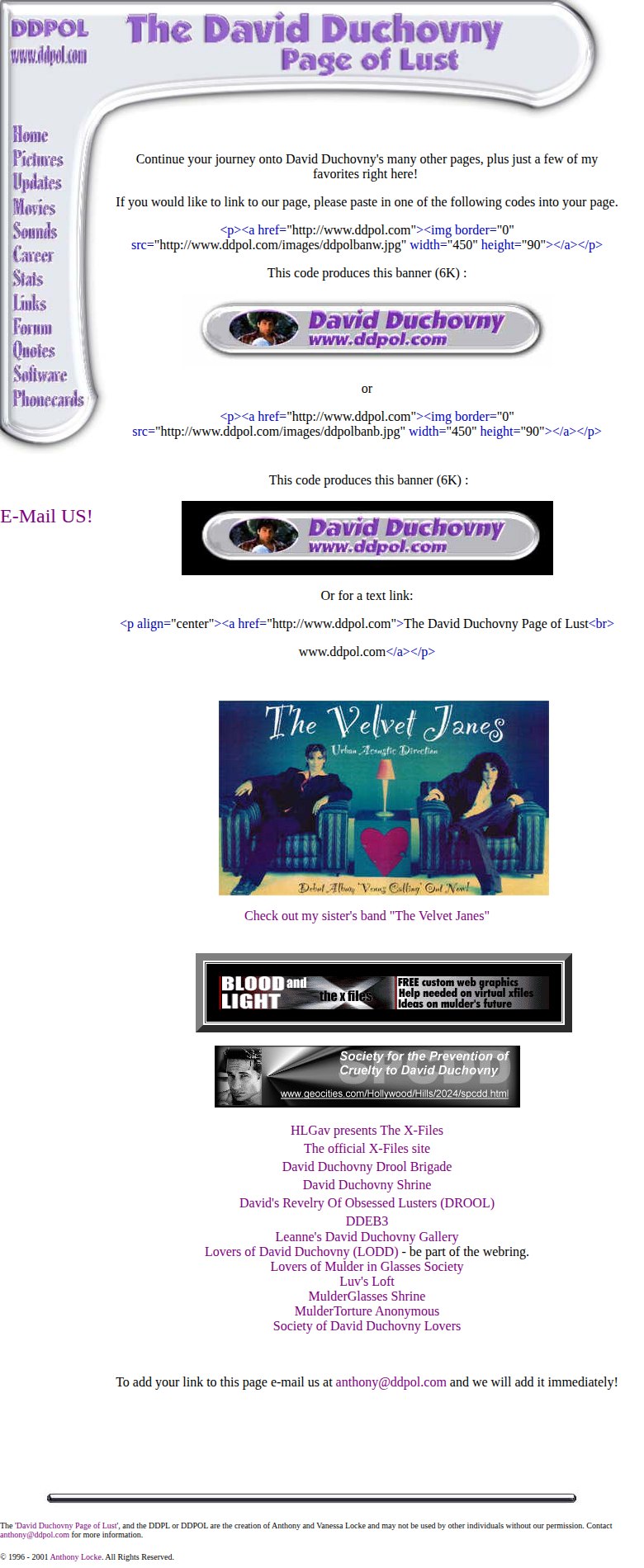
Every audio clip and video snippet had to be compressed with primitive codecs so users wouldn't drop their connection halfway through. The courtesies of the era are still visible in the surviving pages: our link banners are annotated “This code produces this banner (6K)”, and a plain-text alternative is offered immediately below, for anyone who couldn't spare the six kilobytes.
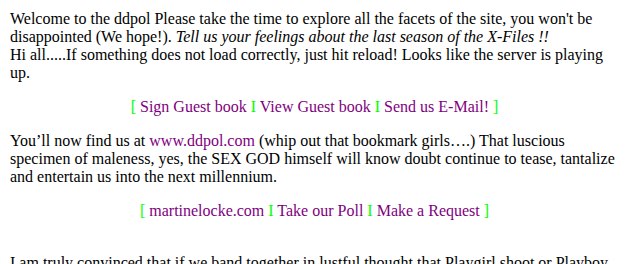
Tracking it all were page counters — the ultimate badge of honour for Web 1.0 webmasters. Ours sat on the home page next to a “View Page Stats” button, ticking upward with every refresh.
Inside the Shrine — A Tour of the Surviving Pages
Because GeoCities was mass-archived before Yahoo! shut it down, DDPOL survives in unusually complete form. Not a stray fragment — very nearly the whole site, still walkable. What follows is what is actually there.
The site was built on HTML framesets, with a header frame, a content frame and a side frame: the dominant layout technology of its moment, and one since removed from the HTML standard entirely. The navigation ran twelve sections deep:
 View full page ↗
2.1 — Pictures
 View full page ↗
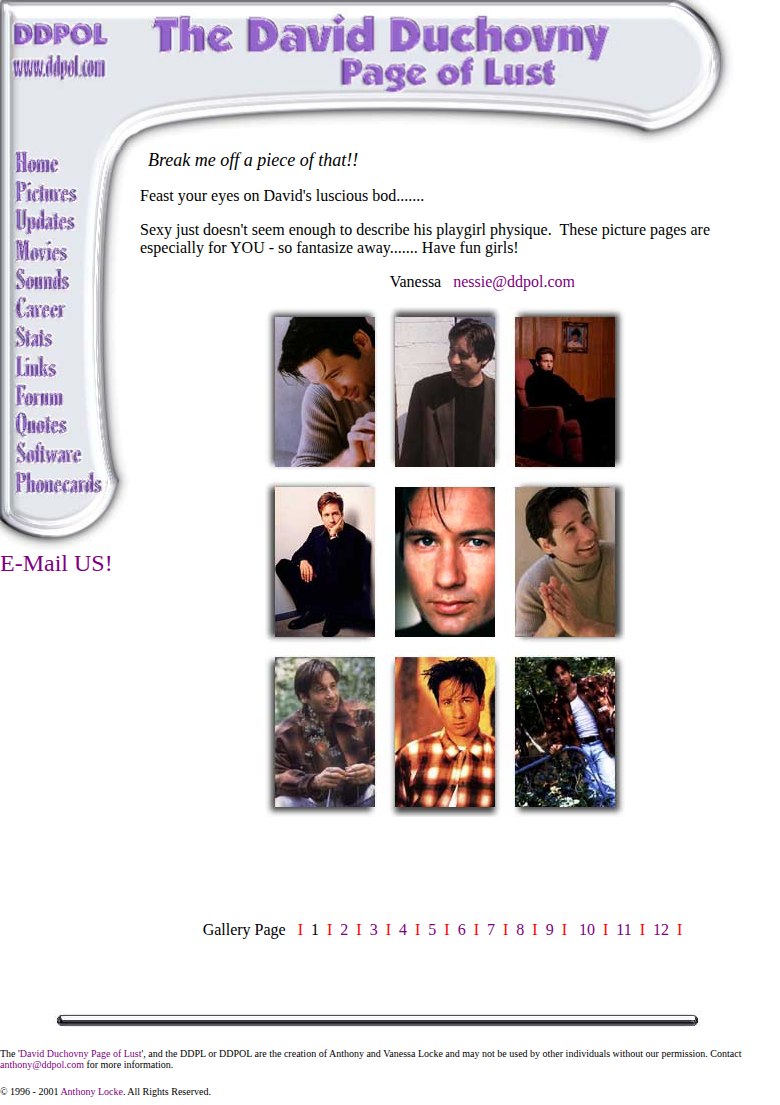
A thumbnail gallery, introduced in the site's characteristic register and signed by Vanessa at nessie@ddpol.com. Galleries were the heaviest thing a fan site could host, and the reason so many homesteads blew through their allowance.
2.2 — Stats: two fact sheets, treated equally
 View full page ↗
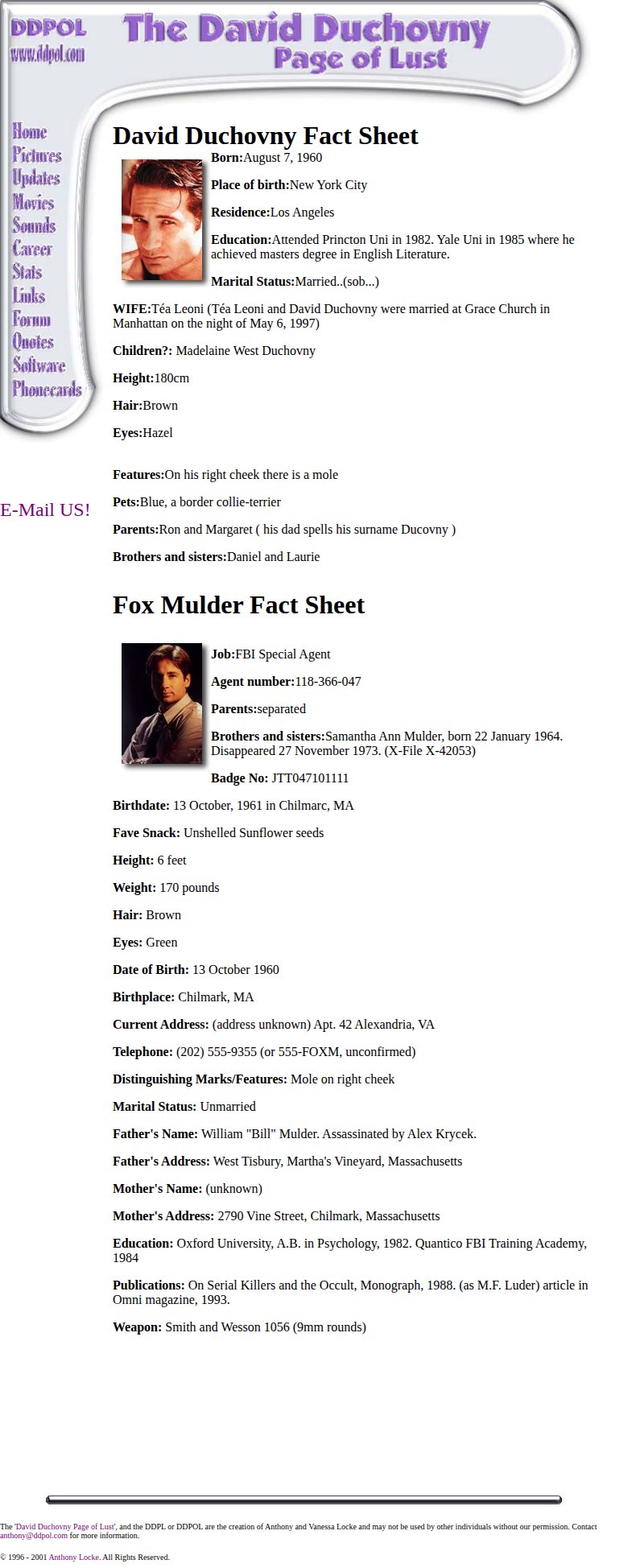
Two parallel fact sheets — one for David Duchovny, one for Fox Mulder — compiled with identical rigour. Duchovny: born 7 August 1960, New York City; Princeton 1982, Yale 1985 (MA, English Literature); married Téa Leoni at Grace Church, Manhattan, 6 May 1997; a border collie-terrier named Blue. Mulder: FBI badge #118-366-047; born 13 October 1961, Chilmark, Massachusetts; Apartment 42, Alexandria, Virginia.
Setting a real person and a fictional one side by side, documented to the same standard, is the whole epistemology of 1990s celebrity fandom in miniature.
2.3 — Movies and Sounds
 View full page ↗
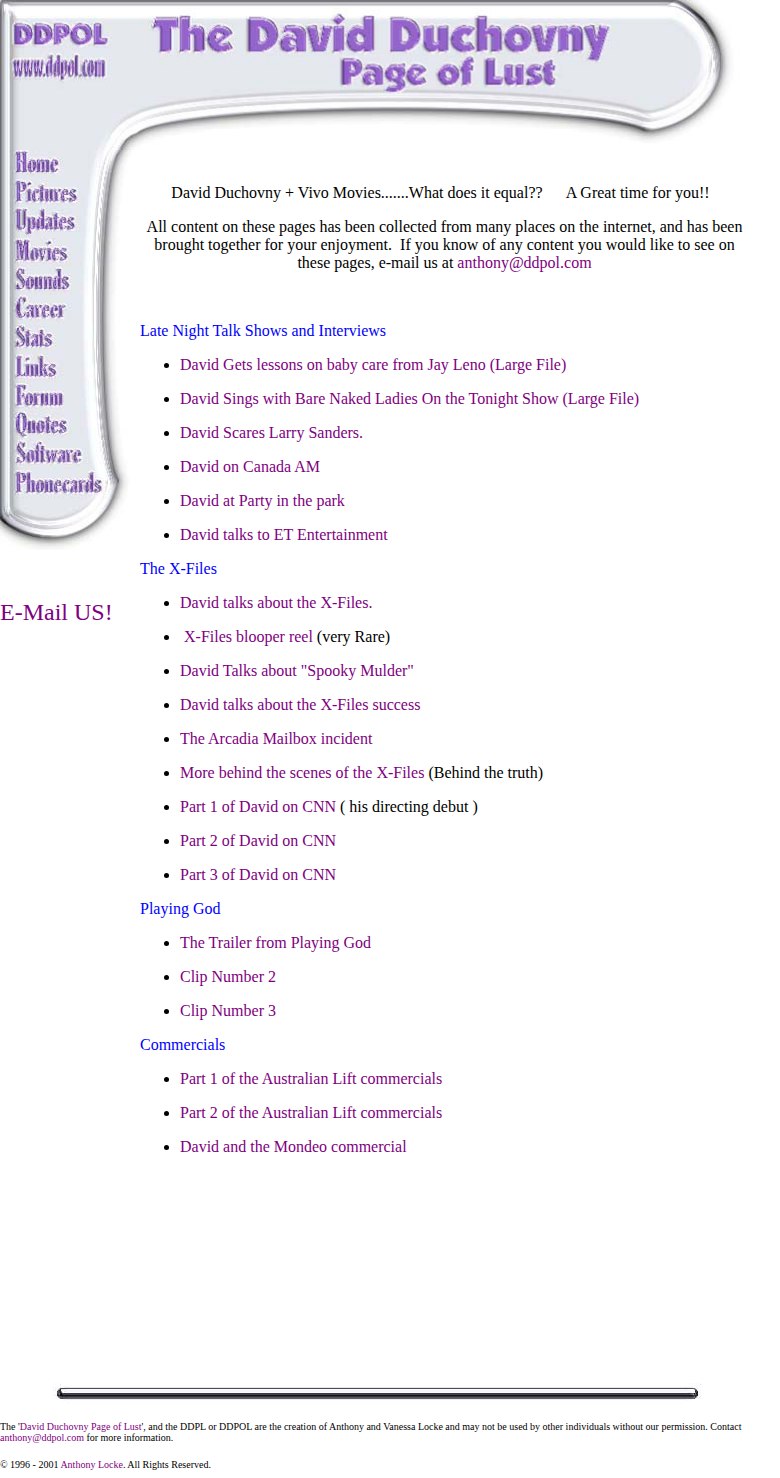
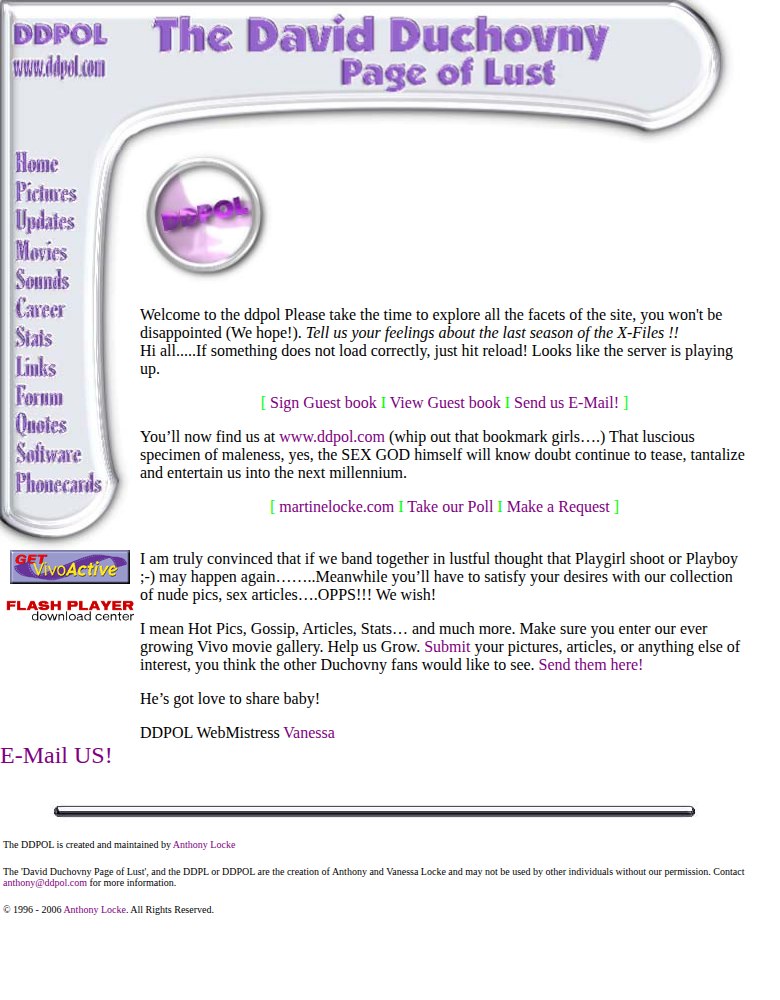
The Movies section was a library of Vivo clips. VivoActive was an early streaming format (H.263 video, G.723 audio) from Vivo Software — prominent in streaming's infancy, with development ceasing in 1997 and RealNetworks acquiring the company in March 1998, after which the format was retired in favour of RealPlayer. The catalogue was organised into “Late Night Talk Shows and Interviews” and “The X-Files,” and included items like “David Sings with Bare Naked Ladies On the Tonight Show” and an X-Files blooper reel marked (very Rare). The page carried a “GET VivoActive” badge and a Flash Player download link — the codec evangelism of a web where nothing played by default.
The page also stated its own sourcing plainly: “All content on these pages has been collected from many places on the internet, and has been brought together for your enjoyment.” That sentence is the honest self-description of an entire genre.
2.4 — Software
 View full page ↗
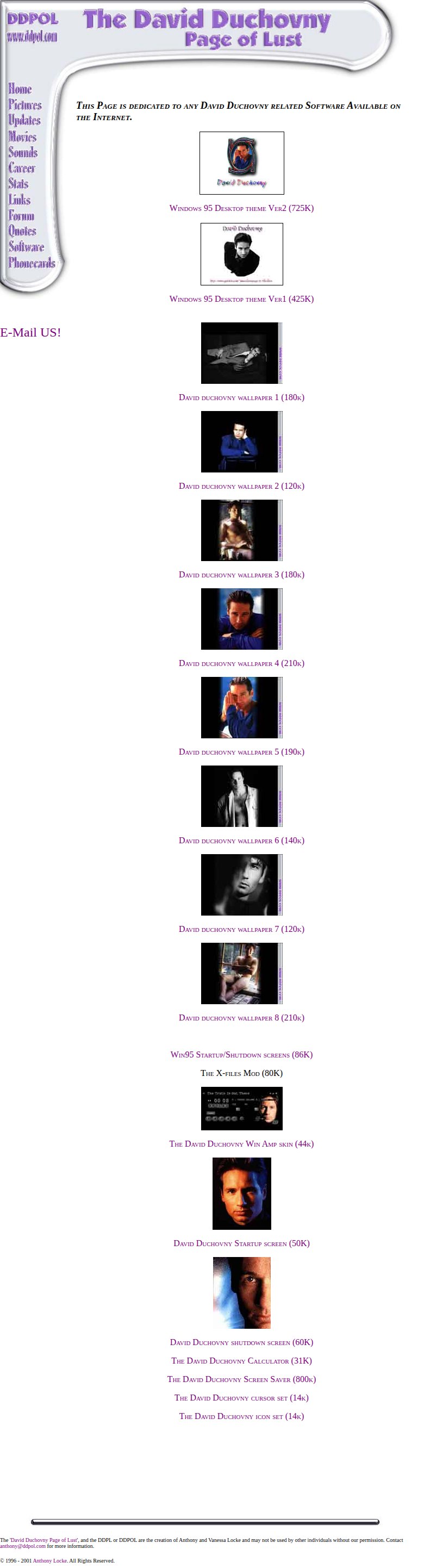
Two Windows 95 desktop themes (725K and 425K) and a run of wallpapers. Desktop themes are among the most precisely dateable artefacts of the period: the idea that devotion should extend to your operating system's colour scheme and system sounds belongs almost exclusively to the Windows 95/98 years.
2.5 — Quotes and Phonecards
 View full page ↗
 View full page ↗
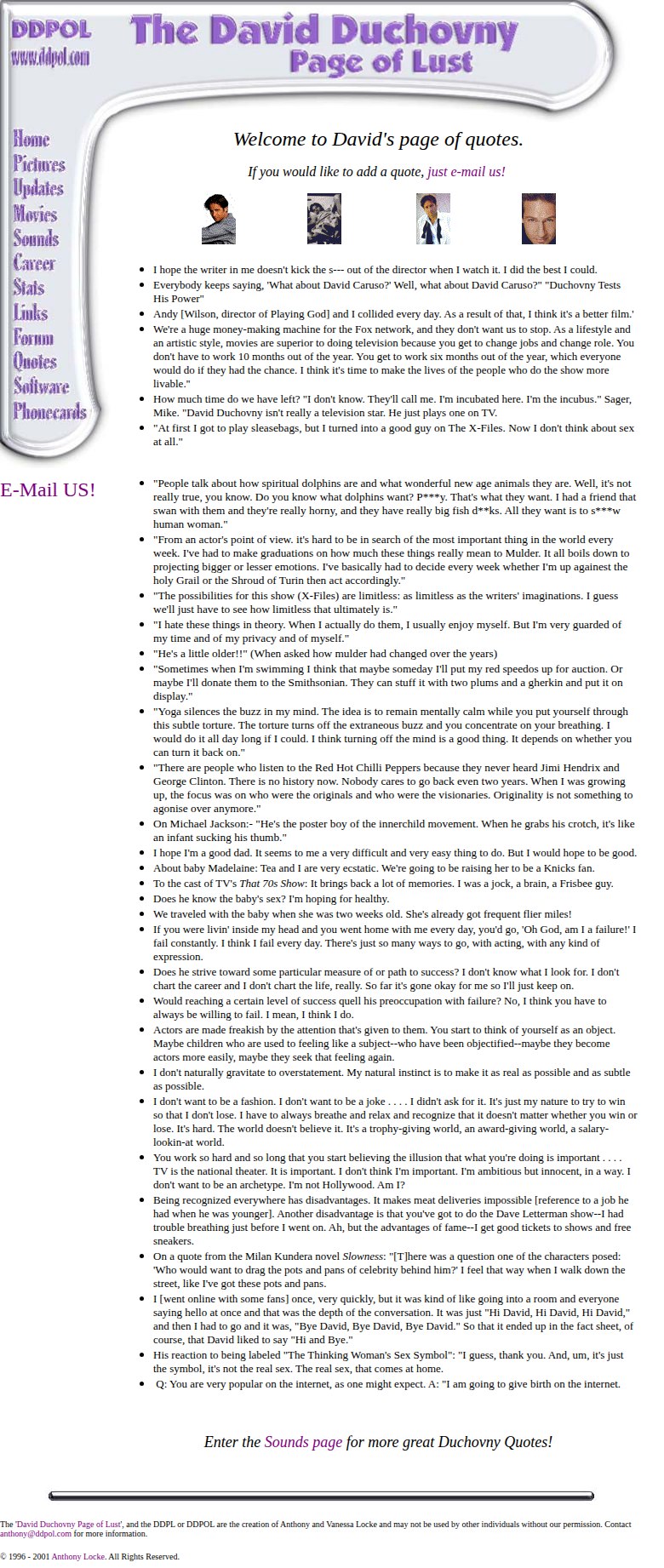
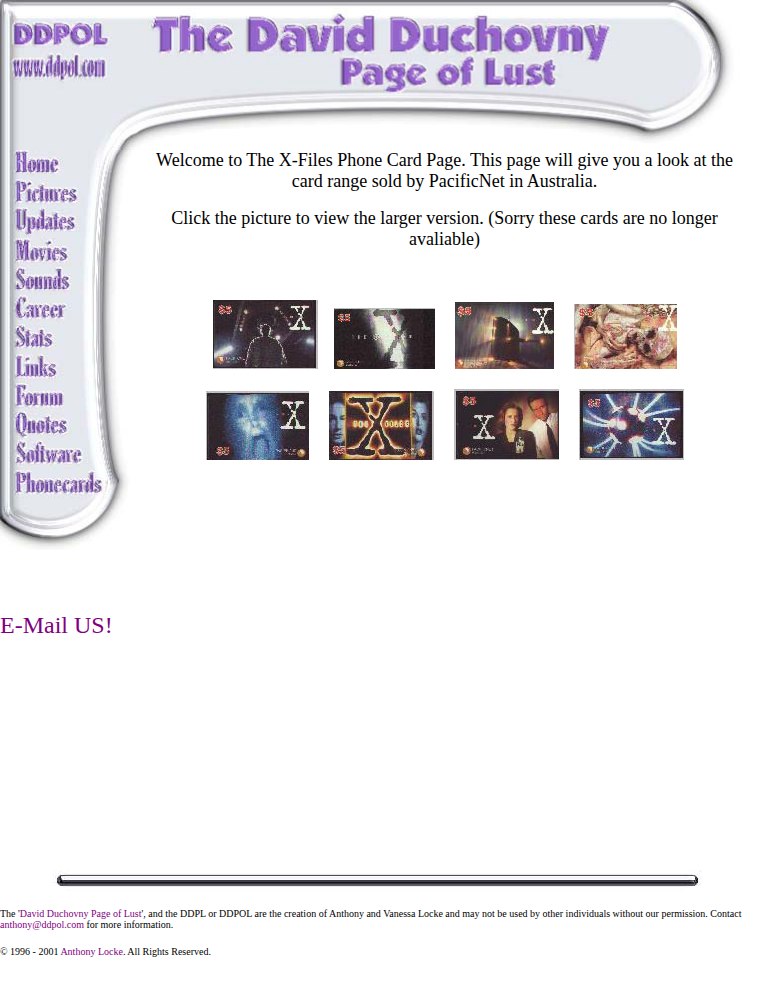
The Quotes page was a hand-collected wall of Duchovny interview lines, crowdsourced from readers — “If you would like to add a quote, just e-mail us!” The Phonecards page catalogued PacificNet's Australian X-Files card range, noting drily that the cards were “no longer avaliable.” It is the kind of hyper-specific collecting subject only a fan site would bother to document, and it now constitutes genuinely scarce material.
2.6 — The machinery of a site that expected to be linked to
DDPOL ran on role-based email addresses on its own domain — webmaster@, copyright@, contribution@, Submission@, link@, nessie@ and anthony@ddpol.com — plus a general contact at duchov@internode.on.net. Running a hobbyist fan page with a departmental email structure was a way of signalling the thing was serious.
The Links page offered two ready-made banners with copy-and-paste HTML for anyone who wanted to link to us:


And the footer asserted, on every single page:
The 'David Duchovny Page of Lust', and the DDPL or DDPOL are the creation of Anthony and Vanessa Locke and may not be used by other individuals without our permission.
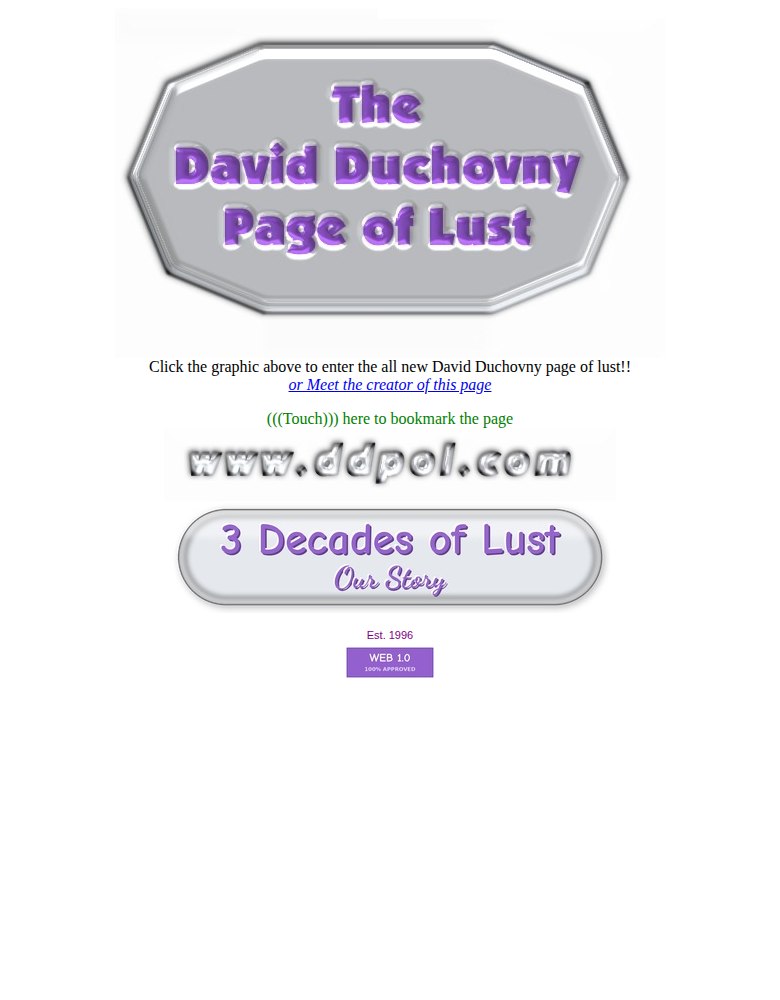
A companion page, DarkLight Design, was linked from the splash screen as “Meet the creator of this page” — the web-design side-business the fan site was quietly incubating. It survives in the archive as a stub reading More Coming Soon!!
The Mainstream Collision — Cyberspace Obsession
3.1 — The Voice of a Fandom
As traditional print and television media scrambled to understand what the “Information Superhighway” actually was, journalists went looking for real-world case studies of online human behaviour. The X-Files fandom was the case study they kept finding, and the sites that made it up — ours among them — became the raw material for a decade of “cyberspace obsession” trend pieces.
┌──────────────────────────────────────────────────────┐
│ MAINSTREAM MEDIA RECOGNITION              │
├──────────────────────────────────────────────────────┴
│ • Cosmopolitan (May 2000): DDPOL mentioned in a  │
│   Duchovny feature — recorded on our own Updates page │
│ • CelebSites: listed in the era's curated celebrity│
│   web directory                                    │
│ • Acronym dictionaries: "DDPOL" formally catalogued│
│ • Wider press coverage of X-Files online fandom, in│
│   which our corner of it was the subject matter      │
└──────────────────────────────────────────────────────┘
3.2 — The Cosmopolitan Milestone (May 2000)
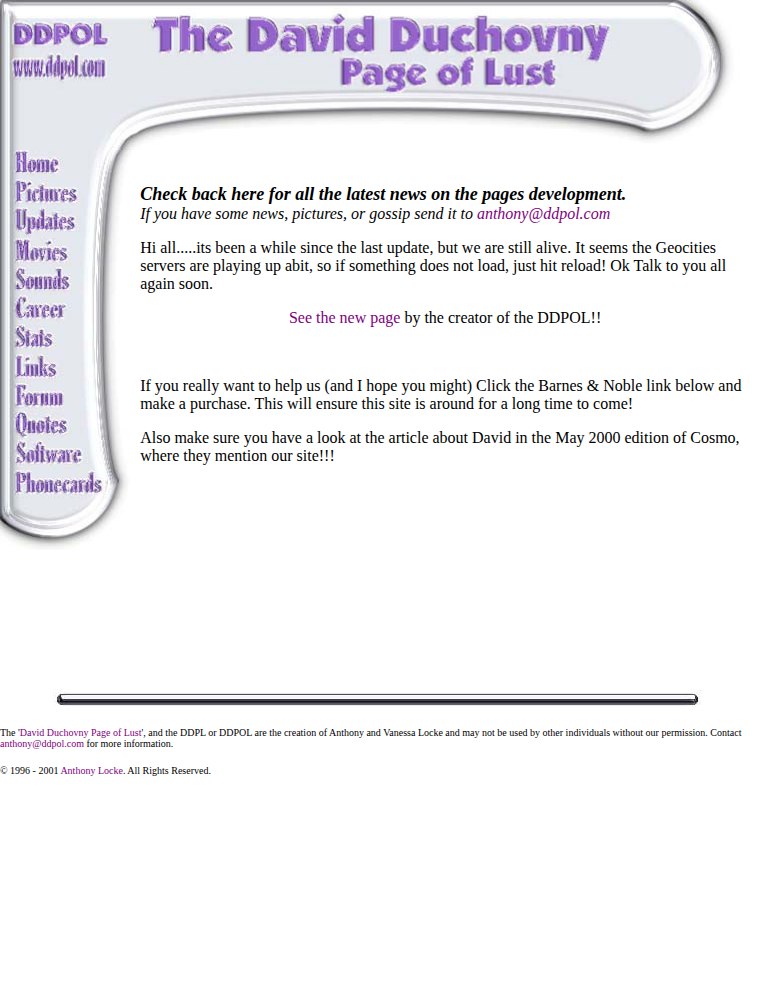
The clearest mainstream marker in the surviving record is one we wrote down ourselves at the time. Our Updates page reads:
Also make sure you have a look at the article about David in the May 2000 edition of Cosmo, where they mention our site!!!

We linked to a reproduction of the piece at cosmo.html. That particular file is not held in the OoCities mirror — it is one of the handful of pages that didn't survive the archiving — though the long-running fan archive duchovny.net independently hosts a page of the same Cosmopolitan article.
Being mentioned in Cosmopolitan — the mass-market authority on relationships and pop culture — was the moment the site crossed from a niche internet destination into something a person could encounter at a newsagent without ever having gone looking for it.
 View full page ↗
3.3 — The May 1997 Flashpoint & Late-Night Echoes
The sharpest test of the fandom's collective mood came in May 1997, when Duchovny married Téa Leoni. The news moved through The X-Files fanbase at the speed the early internet allowed, which was already much faster than print. Guestbooks and forums across the Duchovny web — ours included — filled with the community's lighthearted, performative “heartbreak.” The marriage is duly recorded on our own Stats page, to the date: Grace Church, Manhattan, 6 May 1997.
The prominence of that fandom eventually penetrated the Hollywood bubble. Duchovny was repeatedly asked about his online following during press junkets and television appearances, and characteristically met it with academic amusement and self-deprecation. The stories that circulated among webmasters at the time — of him wandering into a chat room dedicated to himself and being disbelieved and ejected by his own fans — capture the central paradox of Web 1.0 perfectly: the fans had built an ecosystem so autonomous that the celebrity at its centre couldn't easily get in.
Around that same period, we received an email from someone claiming to be David Duchovny himself, thanking us for building the site and for the positive, welcoming fan culture that had grown up around it. There was no practical way, in the late 1990s, to verify that an email address belonged to who it claimed to belong to — no blue check marks, no verified accounts, nothing but the words on the screen. We have never been able to confirm, one way or the other, whether it was genuinely him or someone having a very good laugh at our expense. To this day, we still find ourselves wondering.
Architecture of the Early Web — The Link Economy
4.1 — Discovery Before Search
Before search engine optimisation and centralising corporate platforms existed, discovery on the internet was entirely cooperative. You found a site because another site had chosen to send you there.
Web rings were decentralised networks of independent sites bound together by a shared topic and a common snippet of HTML: a navigation bar letting users click “Previous,” “Next” or “Random” to jump to another site in the ring. The effect was to keep visitors circulating inside a curated loop of fan-made content, entirely independent of corporate control.
DDPOL's own contribution to this economy is preserved in full: a dedicated Links page, two downloadable link banners with published file sizes, a plain-text link alternative, and a submissions address at link@ddpol.com for anyone who wanted to be added.
 View full page ↗
4.2 — Interactive Artifacts: Guestbooks and Hit Counters
The social layer of DDPOL was built on Web 1.0 interactive artefacts, primarily the Guestbook. Without the ability to “Like” or “Retweet,” the guestbook was the only way a visitor could leave a permanent footprint. The home page carried the full set of period controls in a single line — Sign Guest book | View Guest book | Send us E-Mail! — alongside a visitor poll, a request form, and a page-stats button.
Combined with a hit counter that ticked upward on every refresh, these gave a real-time public display of a community that was demonstrably international. The guestbook entries themselves did not survive the archiving; the machinery that collected them did.
4.3 — The Shift to Web 2.0 and Digital Preservation
By the early 2000s the architecture of the internet was shifting. Database-driven forums, blogging platforms like LiveJournal, and corporate hosts like Yahoo! — which bought GeoCities in 1999 and closed it in 2009 — dismantled the classic web ring system. Hand-maintained HTML sites required upkeep that became harder to justify against automated Web 2.0 frameworks.
When ddpol.com eventually went offline, the site did not vanish. GeoCities was mass-archived ahead of its shutdown by the Internet Archive, Archive Team and mirror projects including OoCities, ReoCities and GeoCities.ws. Today the OoCities mirror preserves DDPOL's layouts, text and graphics — the site frozen in digital amber as a reference point for early web design.
The acronym DDPOL has its own, separate afterlife. It is catalogued as a defined term — “DDPOL — David Duchovny Page of Lust (fan site)” — in general-purpose reference works including AcronymFinder, AcronymsAndSlang and TheFreeDictionary's acronym database, filed alongside sibling entries like DDIJ (David Duchovny in Jeans) and ACodd (Almighty Cult of David Duchovny). Being lexicalised — treated as a term worth defining rather than a site worth visiting — is a modest but genuine marker of cultural penetration, and one most fan sites never achieved.
The Upper Echelons of Philedom — DDPOL's Contemporaries
To understand DDPOL's place, you have to look at the ecosystem running concurrently in the late '90s. Our own Links page is the best surviving evidence of it: a sociogram of who we thought was worth sending our visitors to.
DDPOL.com
Visual media archive & commentary
DDEB
The early mailing list & star-worship community
The Gossamer Project
The internet's largest fanfic hub
alt.tv.x-files
The massive Usenet discussion board
Cliff Chen's FAQ
The definitive data & lore repository
The archived DDPOL Links page names, among others: DDEB3, the David Duchovny Drool Brigade, David's Revelry Of Obsessed Lusters (DROOL), Lovers of David Duchovny (LODD), the Society of David Duchovny Lovers, the David Duchovny Shrine, the Lovers of Mulder in Glasses Society, the MulderGlasses Shrine, MulderTorture Anonymous, Leanne's David Duchovny Gallery, Luv's Loft, HLGav presents The X-Files, and the official X-Files site.
The naming convention alone — DDEB, DROOL, LODD, DDPOL — tells you these groups were reading each other, borrowing from each other, and competing gently for the same audience.
5.1 — The David Duchovny Estrogen Brigade (DDEB)
- The Site: Started in the mid-1990s by a fan with roots in Star Trek fan communities, DDEB was a women-only mailing-list community organised around frank appreciation of Duchovny. It grew large enough to spawn numbered chapters — DDPOL linked to DDEB3 — and became the template that later “Estrogen Brigades” copied across other fandoms. A male counterpart, the Gillian Anderson Testosterone Brigade, followed and stayed smaller.
- The League: Where DDPOL was a media archive, DDEB was list infrastructure and conversation. Together they covered the two halves of the same fandom. DDEB in particular attracted sustained academic attention — it is the subject of peer-reviewed work on women's online spaces, including the frequently cited study “X-clusively female: the cyberspaces of the David Duchovny estrogen brigades.”
5.2 — The Gossamer Project (“Goss”)
- The Site: The undisputed leviathan of early text archiving — a vast repository preserving and categorising X-Files fan fiction. The original archive was opened on 4 May 1995 by Vincent Juodvalkis, mirroring files from older FTP sites; the Gossamer Project proper began in August 1996, when a fan known as Natasha (Kelsy) started the cataloguing effort.
- The League: Gossamer was one of the “big three” single-fandom archives of the mid-to-late 1990s and remained the largest single-show fan fiction archive on the web until the Harry Potter boom of the early 2000s. By April 2007 it held over 35,000 entries; its peak year, 2000, processed roughly 9,000 submissions. It drew coverage from The New York Times (1997), Entertainment Weekly (1998) and The Washington Post (2001) — the clearest case of an amateur X-Files archive being treated as news by the mainstream press.
5.3 — Cliff Chen's X-Files FAQ
- The Site: The encyclopaedic bible of the fandom, curated by Cliff Chen.
- The League: Before Wikipedia or centralised fan wikis, this was the thorough text repository of production notes, timelines and dense narrative lore. If a fan needed to settle a debate about the alien conspiracy mythology, this was the archive they checked. Contemporary accounts describe it as “slightly dated but extremely thorough” — the highest compliment the era paid a reference work.
5.4 — alt.tv.x-files (ATX)
- The Site: Operating on Usenet, the decentralised, text-based precursor to modern web forums.
- The League: Fan activity on alt.tv.x-files began within roughly three months of the September 1993 pilot — before Fox's own official website existed, which did not launch until June 1995. ATX was a high-volume discussion board where thousands of “X-Philes” analysed episodes immediately after broadcast. It is where “shipping” was born, coined by fans debating whether Mulder and Scully should be romantically paired; the term is now standard across every fandom on the internet. In the show's early years the official online home was a Delphi forum drawing on the order of 25,000 X-Philes a month.
The Historical Collision — Fox Studios vs. The Fan Sites
Operating at this level of traffic in the late '90s inevitably drew the eye of Hollywood executives terrified of losing control of their intellectual property.
Driven by corporate anxiety over copyright, 20th Century Fox began sending legal threats and cease-and-desist letters to X-Files fan sites, demanding removal of copyrighted audio, imagery and episode transcripts. The practice became so routine that fans coined a verb for it: to be Foxed. In response the community organised a campaign — “Free Speech Is Out There: Protecting X-Phile Web Sites” — to share legal information and coordinate a public response.
DDPOL sat squarely in the risk zone. Photo galleries, sound files, Vivo clips of talk-show appearances, desktop themes built from publicity stills: almost everything that made the site worth visiting was, strictly speaking, someone else's property. Read in that light, two details on the surviving pages take on a different colour — the careful disclaimer that content was “collected from many places on the internet”, and the firm assertion of copyright in our own names over the site's own design and branding.
The eventual outcome was less a single victory than a slow recalibration. Studios gradually came to understand that independent fan sites were not primarily threats to be sued but the organic marketing engine keeping their shows alive between seasons — a realisation that shaped how entertainment companies have handled online fandom ever since.
The Legacy of Digital Fandom — Inventing the “Stan”
7.1 — The Blueprint for Modern Internet Culture
The historical significance of sites like DDPOL extends far beyond The X-Files. Decades before “stan culture,” “shipping” or “viral marketing” entered the mainstream lexicon, this generation of fan sites was practising all three.
Web 1.0 — DDPOL (1996)
Manual HTML coding · Cooperative link economy · Complete fan autonomy
Web 2.0 — Forums / Tumblr (2010)
Centralized platforms · Fandom “shipping” culture · Corporate monetization
Web 3.0 — TikTok / X (2026)
Algorithmic feeds · Instant global trends · Manufactured virality
It proved that an organised, enthusiastic online community could generate enormous attention purely through grassroots, word-of-mouth interaction — and it demonstrated to television executives that a show's survival was tethered to the passion of its online fanbase.
7.2 — What Actually Makes DDPOL Worth Preserving
Three things, none of which depend on press clippings.
It is unusually complete. Most of the amateur web of the 1990s is gone, and what survives usually survives in pieces — an orphaned page, a broken gallery, a dead guestbook. DDPOL survives close to whole: masthead, navigation, and every major section still there and still walkable, with only a handful of files missing from the mirror.
It documents a specific technological moment with precision. Framesets. Vivo streaming. Windows 95 desktop themes. File sizes disclosed in kilobytes as a courtesy. Hand-lettered JPEG navigation buttons. Guestbooks, hit counters, a visitor poll. An affiliate link to Barnes & Noble as a funding model — “Click the Barnes & Noble link below and make a purchase. This will ensure this site is around for a long time to come!” Each of these was current for only a few years. Finding all of them on one site is close to a stratigraphic section of the late-1990s web.
It shows the amateur web behaving professionally. A domain, a masthead, a brand mark, departmental email addresses, an update log, submission guidelines, ready-made link banners with published file sizes, a copyright policy asserted in its creators' own names, and a spun-off design studio. None of it was required of a hobby page. All of it reflects an instinct — widely shared across the GeoCities generation, largely forgotten in the platform era — that if you were going to put something on the web, you built the whole institution around it yourself.
7.3 — Independent Freedom vs. Algorithmic Control
Looking back at the DDPOL era highlights a stark contrast with the modern internet. Today's fan communities live inside the uniform, monetised walls of corporate social networks, where visibility is dictated by opaque algorithms designed to maximise ad revenue.
DDPOL represents a golden age of digital autonomy: an era when two people could sit down with an internet connection, write their own code, buy a domain name and build something that strangers on the other side of the world would find, use and come back to. The David Duchovny Page of Lust remains a small monument to what the World Wide Web was always intended to be — creative, decentralised, and joyfully chaotic, built by the fans, for the fans.
 View full page ↗
Three Decades, at a Glance
How This History Was Compiled
This history draws on two kinds of material, and it is worth being clear which is which.
The surviving pages. Everything described in Chapters 2 and 4, the Links page roll-call in Chapter 5, the Cosmopolitan note in Chapter 3, the email addresses, the copyright lines, the file sizes and the section structure are all taken directly from the archived site at OoCities. Every image referenced in this document was captured from those pages and cropped only to remove the archive's own banner and advertising column.
Recollection. The Introduction, and the passages explicitly flagged in Chapters 3 and 6, are our own memory of events. Where we could not find surviving documentation — for DDPOL being named on air, or Duchovny referring to the site by name — we have said so rather than supply a citation we cannot stand behind. Pre-2000 television transcripts, regional press and magazine back-issues are poorly indexed online, and a great deal of contemporaneous fan documentation went down with GeoCities in 2009.
The photographic content on the original site — publicity stills and phonecard scans — was, by the site's own account, collected from around the internet and is likely third-party copyrighted material. The DDPOL-original graphics (masthead, navigation buttons, splash logo, wordmark and link banners) are our own design work.
References & Further Reading
The archived site
- Splash page · Home · Updates
- Pictures · Fact sheets · Career
- Links and banners · Vivo movies
- Quotes · Software · Phonecards
Reference and context
- DDPOL — AcronymFinder · AcronymsAndSlang · TheFreeDictionary
- GeoCities — Wikipedia
- Vivo Software — Wikipedia
- The Gossamer Project — Wikipedia
- How Horny X-Files Lovers Created a New Type of Online Fandom — Gizmodo
- “This Has Something To Do With Computers, Doesn't It? The Internet?” — Contingent Magazine
- The X-Files: A History of the Fandom — Den of Geek
- The X-Files X-Posed — Mental Floss
- David Duchovny Estrogen Brigade — Fanlore
- Free Speech Is Out There: Protecting X-Phile Web Sites — Fanlore
- “X-clusively female: the cyberspaces of the David Duchovny estrogen brigades”
- Cosmopolitan Duchovny article, archived at duchovny.net